Build a Rotating Solar System Orrery Wooden Kit
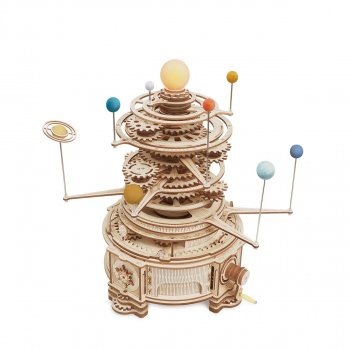
Rotatable Mechanical Solar System DIY Wooden Model Kit: A Kinetic Desk Model You Build Yourself
A mechanical solar system model is equal parts build, lesson, and display piece. This rotatable DIY wooden kit turns a set of precision-cut components into a working orrery-style sculpture with gears and moving planets—ideal for hobbyists, STEM learners, and anyone who enjoys kinetic décor that feels earned because it was assembled by hand.
If you’re shopping for a build that lands somewhere between a relaxing puzzle and a light engineering project, the Rotatable Mechanical Solar System DIY Wooden Model Kit is designed to reward patience with motion you can see and feel.
What this kit is and what makes it satisfying
At its core, this is a DIY wooden mechanical model designed to rotate and simulate orbital motion through linked gears. Instead of a static “look-only” display, you’re building a mechanism: axles must sit correctly, gear teeth must mesh cleanly, and frames need to stay square so the system can turn smoothly.
That’s where the satisfaction comes from. The build experience blends puzzle-solving with light engineering—aligning shafts, checking spacing, and learning (quickly) how a tiny tilt can change how the entire model behaves. When it’s complete, the finished piece works as an interactive display; movement makes it far more engaging than a fixed solar system ornament.
It also fits a lot of real-life use cases: a focused weekend project, a classroom demonstration piece, or a gift for someone who likes hands-on builds more than ready-made décor.
Build experience: what to expect from assembly
A smooth assembly starts before anything is permanently joined. Preparation helps: sort pieces, identify gear sets, and dry-fit key subassemblies (especially any layered frames and axle supports) before final joining. This small step prevents the most common frustration—building too far ahead before noticing a slight skew.
Precision matters more with moving models than with decorative kits. Keep gear teeth clean, avoid forcing tight parts, and confirm smooth rotation at each stage. If a joint is snug, it’s usually better to lightly refine it than to push harder; forced parts can compress wood fibers and subtly change clearances in a way that shows up later as friction.
A pacing tip that saves time: test the mechanism frequently. Small misalignments are easier to fix early than after the outer frame is complete. As you build, treat each section like a “checkpoint”—spin it, feel for resistance, listen for clicking, and only then move to the next layer.
A simple setup makes the whole experience more enjoyable: a flat surface, good lighting, a small file or fine sandpaper for snug joints, and a tray or bowl for small parts so nothing rolls away mid-build.
Movement and mechanics: how the rotating system comes together
The model’s motion comes from gear trains transferring movement from the drive point to multiple arms, creating coordinated rotation. That coordinated feel—several elements turning together—is what makes an orrery-inspired build so mesmerizing on a desk or shelf.
Smooth motion depends on consistent spacing and low friction. If something catches, it’s usually one of a few fixable issues: rubbing edges, tilted axles, or slightly warped pieces that press where they shouldn’t. When motion feels stiff, inspect gear mesh (too tight), axle alignment (not perpendicular), and any debris in the teeth (tiny splinters can act like brakes).
For longevity as a display piece, keep it dusted and avoid humid storage. Wood can swell in high humidity, tightening tolerances and making a previously smooth mechanism feel resistant. If your environment changes seasonally, a quick re-check of axle straightness and a gentle smoothing of high-friction contact points can restore easy rotation.
Quick feature checklist
At-a-glance checklist for a smooth build
| Step | What to check | Why it matters |
|---|---|---|
| Dry-fit key frames | Parts seat fully without bending | Prevents misalignment that binds gears later |
| Test each gear stage | Rotation is smooth before adding the next layer | Isolates friction points early |
| Keep axles square | Shafts sit perpendicular to frames | Reduces wobble and uneven gear wear |
| Clear gear teeth | No splinters/debris in teeth | Avoids clicking, skipping, and jamming |
| Final rotation test | Full cycle turns without sticking | Ensures the display works reliably |
Who it’s best for (and who may want something else)
Display and care tips for long-lasting motion
For a little extra context on the real-world inspiration behind gear-driven planetary models, explore NASA Solar System Exploration and the Smithsonian’s overview of an orrery.
Related build ideas for gifting and collecting
A kinetic model makes a great centerpiece, and it pairs well with a contrasting build style. For a themed “maker gift” set, consider adding a decorative puzzle kit that emphasizes form and pattern rather than mechanics—like the DIY Wooden Bloom Box 3D Puzzle Kit. The combination feels curated: one project teaches motion and gear logic, the other leans into design and display aesthetics.
FAQ
Is this kit suitable for beginners?
Yes for patient beginners. Dry-fit parts, test rotation often, and take breaks rather than forcing tight joints so the gears stay aligned and the motion remains smooth.
Does the model actually rotate after assembly?
It’s designed to rotate through a connected gear mechanism. Smooth motion depends on correct alignment, clean gear teeth, and keeping axles square during assembly.
How long does it take to build and what tools help most?
Build time varies by experience and pacing, but it’s best planned as a focused session (or a relaxed weekend project). Good lighting, a tray for small parts, and fine sandpaper or a small file help most with snug joints and clean movement.














Leave a comment