Calmer Flying Tools: Beat Flight Anxiety Step by Step
Wings Without Worry: A Practical Guide to Calmer Flying
Flight anxiety can show up as racing thoughts, a tight chest, sweaty palms, or an urge to avoid travel altogether. The good news is that calmer flying usually isn’t about “forcing confidence”—it’s about using practical, repeatable tools before, during, and after the flight so your body learns, trip by trip, that you can handle the sensations and uncertainty.
Why fear of flying feels so intense
Flying stacks several common anxiety triggers at once: uncertainty (What if something goes wrong?), loss of control (I can’t just pull over), and intense physical sensations (takeoff power, vibration, turbulence). For many nervous flyers, panic symptoms themselves become the “threat,” because a racing heart or lightheadedness can feel like danger even when it’s simply adrenaline.
Your body’s threat system is built to detect risk quickly—and it can misread harmless cues in an airplane as warning signs: engine pitch changes, bumps, cabin smells, even the feeling of being enclosed. One reason fear persists is the avoidance cycle: canceling a flight or “white-knuckling” through without any coping plan may reduce anxiety short-term, but it often strengthens the fear long-term because your brain never gets fresh evidence that you can cope.
A calmer flight often starts with understanding this pattern rather than fighting the feeling. Anxiety is loud, but it’s not always accurate.
What calm can realistically look like
“No anxiety” is an inspiring idea, but it’s rarely the most helpful goal. A more realistic target is manageable anxiety with steady choices: you feel nerves and still board, breathe, and follow your plan.
- Progress markers: getting to the airport, boarding, staying seated during turbulence, completing the flight.
- Helpful mindset: anxiety is uncomfortable, not dangerous; skills reduce intensity over time.
Pre-flight plan: 72 hours to boarding
Preparation reduces “mystery,” which is fuel for fear. In the 1–3 days before travel, focus on smoothing out uncertainty and stabilizing your body so normal flight sensations don’t get misinterpreted as panic.
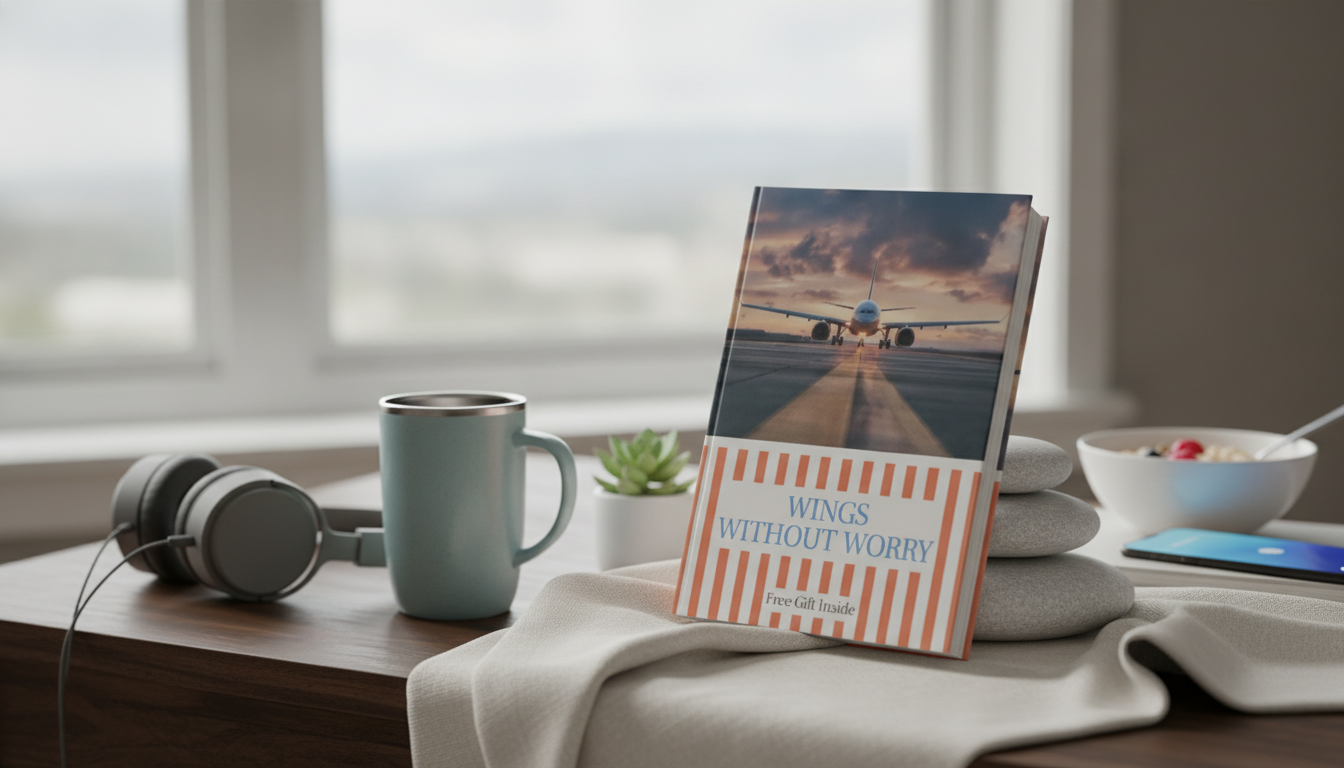
For a structured, travel-ready routine that’s easy to follow, keep a simple checklist on your phone. The Wings Without Worry digital download is designed to reduce decision fatigue by telling you what to do next—before boarding, during turbulence, and on descent—when your brain wants to spiral.
At the airport: preventing the anxiety spiral
Lowering overall stress before boarding helps. Wrinkle-free, organized packing can reduce that last-minute “something’s wrong” feeling—especially if you’re heading into meetings or events. A compact tool like the Portable Handheld Fabric Steamer can make it easier to feel put-together without adding extra errands when you arrive.
On the plane: step-by-step tools for takeoff, cruising, and landing
Before pushback
Takeoff
Turbulence
Cruising
Practice thought defusion: treat scary thoughts as background noise—acknowledge (“There’s the fear story”), name it, and return to a task. A hands-on activity can anchor attention when your mind tries to time the next bump. If you like tactile focus, the DIY Wooden Bloom Box 3D Puzzle Kit is a satisfying, screen-free option to work on between trips (and it can build the same “stay present” muscle you use in-flight).
Body reset (any phase)
Landing
Quick calm tools by flight moment
| Flight moment | What anxiety commonly says | What to do for 60–120 seconds |
|---|---|---|
| Boarding | “I can’t handle being trapped.” | Ground feet, look for 3 neutral objects, breathe out slowly for 6–8 counts. |
| Takeoff | “Something is wrong.” | Name sensations as normal; relax jaw/shoulders; count 10 slow exhales. |
| Turbulence | “This is dangerous.” | Sit back, keep seatbelt snug, do box breathing, focus on a steady point. |
| Cruise | “When will it hit again?” | Switch to a task: music, puzzle, or reading; set a 5-minute timer and re-check in. |
| Descent/Landing | “I’m about to panic.” | Repeat your takeoff routine; tighten and release leg muscles; exhale longer than inhale. |
Building confidence after the flight
Digital support that fits in a carry-on
For additional context on anxiety and panic, see the American Psychological Association overview of anxiety and the NHS guide to panic disorder. For turbulence basics, the Federal Aviation Administration (FAA) is a reliable reference point.
Recommended digital download: Wings Without Worry
The Wings Without Worry digital download is designed as a practical support guide for calming flight anxiety and reducing avoidance. It’s useful for first-time nervous flyers and frequent travelers who still dread specific moments like takeoff, turbulence, or feeling confined. Best results come from using it before travel and keeping a few key pages easy to pull up during the flight.
Simple travel comforts that support a calmer trip
FAQ
What should be done if a panic attack starts mid-flight?
Slow the exhale first (make it longer than the inhale), then ground through physical cues like your feet on the floor and your back against the seat. Name the sensations as anxiety—not danger—and follow a short script or checklist until the wave passes; if needed, tell a flight attendant you’re feeling anxious and could use practical support.
Is turbulence dangerous for commercial flights?
Turbulence is common, and commercial aircraft are designed and tested to handle it. The main safety step is keeping your seatbelt fastened when seated to help prevent injury, because discomfort doesn’t automatically mean danger.
How long does it take to reduce fear of flying?
Many people notice improvement quickly once they practice a consistent routine, but longer-term change often comes from repeated flights and structured exposure over time. Tracking small wins and repeating the same core tools helps your brain learn that you can cope.















Leave a comment